

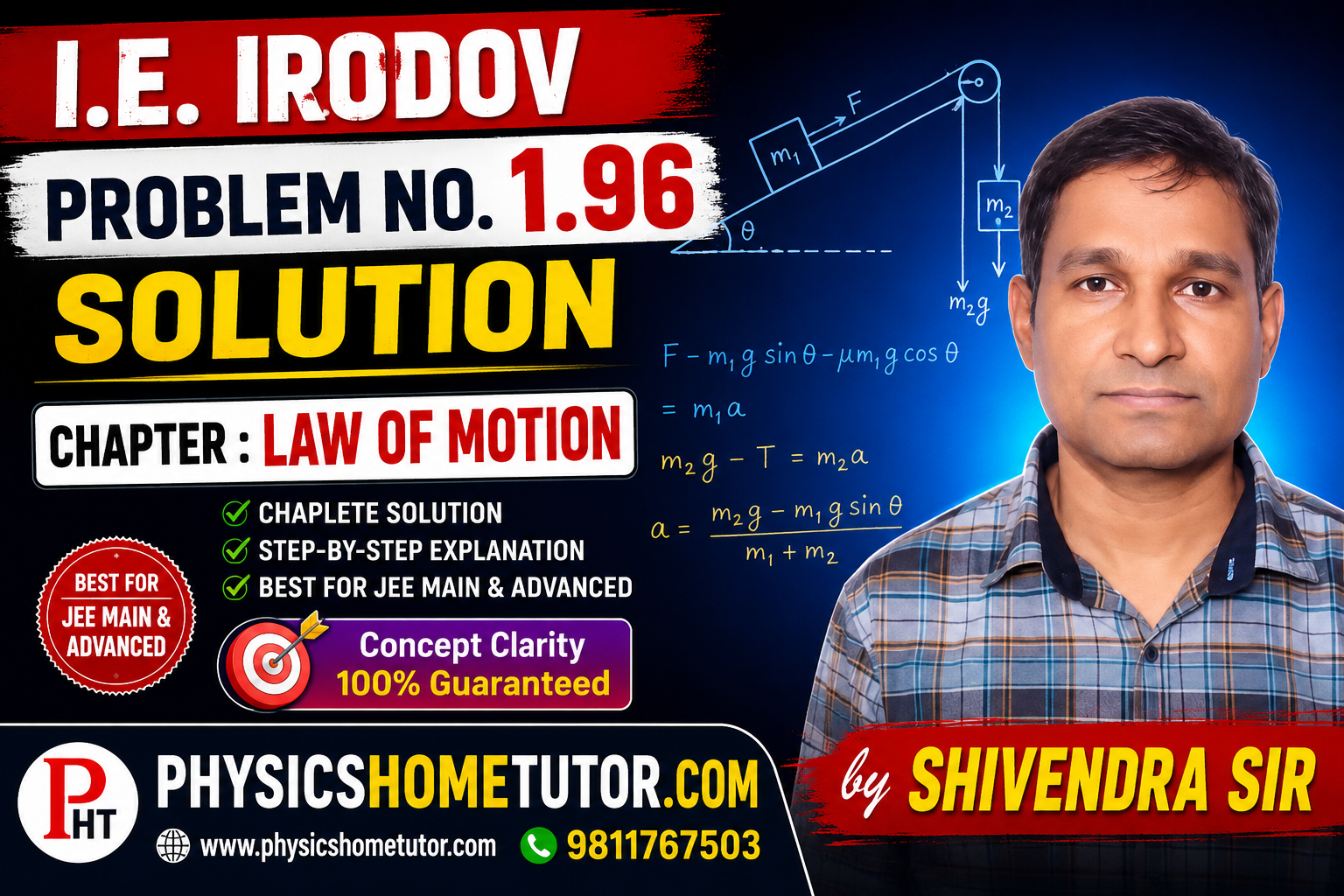



I.E. Irodov Problem No. 1.96 Solution is an important problem for students who want to strengthen their understanding of Newton’s Laws of Motion and mechanics. Irodov problems are known for testing conceptual understanding rather than simple formula substitution. Therefore, solving them systematically can significantly improve problem-solving skills for JEE Main, JEE Advanced, Physics Olympiads, and other competitive examinations.
The Law of Motion chapter forms one of the most important foundations of classical mechanics. Before attempting an advanced problem such as Irodov 1.96, students should be comfortable with: Newton’s First Law Newton’s Second Law Newton’s Third Law Free-body diagrams Tension and normal reaction Friction Acceleration Equations of motion Resolution of forces The main difficulty in an Irodov Physics Problem is generally not mathematical calculation. The real challenge is correctly understanding the physical situation and translating it into equations. How to Approach Irodov Problem No. 1.96 A reliable strategy for solving Irodov Problem 1.96 is to follow these steps. Step 1: Understand the Physical Situation Read the problem carefully and identify: The objects involved Their masses External forces Direction of motion Constraints between the bodies Frictional or contact forces Any acceleration or velocity conditions Do not immediately start writing equations. First understand what the problem is physically describing. Step 2: Draw the Free-Body Diagram A Free Body Diagram (FBD) is one of the most useful tools for solving I.E. Irodov problems. For every body, identify all the forces acting on it. Typical forces include: Weight: W=mg Normal reaction: N Friction: f=μN Tension: T The direction of each force must be chosen carefully. Step 3: Choose the Coordinate System Select the coordinate axes according to the geometry of the problem. For an inclined surface, it is usually convenient to take: One axis parallel to the incline One axis perpendicular to the incline The gravitational force can then be resolved as mgsinθ along the incline and mgcosθ perpendicular to the incline. This makes the equations considerably easier to handle. Step 4: Apply Newton’s Second Law Newton's second law is F net =m a For motion along a chosen direction, ∑F=ma The most important point is to maintain a consistent sign convention. For example, if the positive direction is chosen along the acceleration, forces acting in that direction are positive while forces opposite to it are negative. Step 5: Consider the Constraint Conditions Many Irodov problems involve two or more bodies connected by a string, pulley, rod, or another mechanical constraint. In an ideal string-pulley arrangement, the connected bodies may have related accelerations. Such relationships should be written before solving the simultaneous equations. This is an important technique for Irodov Laws of Motion Problems. Importance of Free-Body Diagrams in Irodov Problems Students often make mistakes because they directly apply formulas without identifying the forces. A properly drawn FBD helps you determine: Which forces act on the body. Which forces oppose the motion. Which forces contribute to acceleration. How friction should be included. How tension or normal reaction should be treated. For difficult Irodov Physics Problems, the FBD often provides the key to the entire solution. Common Mistakes While Solving Irodov Problem 1.96 1. Choosing the Wrong Direction of Positive Axis The positive direction can be selected arbitrarily, but once selected, it must be used consistently throughout the calculation. 2. Ignoring a Force Students sometimes forget normal reaction, tension, friction, or a component of gravitational force. 3. Incorrect Resolution of Forces For an inclined plane, remember that the components of weight depend on the chosen axes. 4. Confusing Action and Reaction Forces Newton’s Third Law forces act on different bodies. They should not simply be cancelled in the free-body diagram of a single body. 5. Using a Formula Without Understanding Its Origin Irodov problems are designed to test conceptual understanding. It is better to derive the required equation using Newton's laws than to memorize a special formula. Irodov Problem 1.96 for JEE Main and JEE Advanced Practicing I.E. Irodov Problem No. 1.96 Solution can be particularly beneficial for students preparing for advanced-level competitive physics. Although JEE Main questions may often involve direct applications of Newton's laws, JEE Advanced Physics frequently requires students to combine several concepts. Irodov problems help develop: Analytical thinking Mathematical modelling Force analysis Vector understanding Multi-step problem solving Physical intuition Students should therefore use Irodov as a conceptual practice resource after developing a strong foundation in Class 11 mechanics. Tips to Master Law of Motion Problems To become comfortable with Law of Motion Problems, follow a systematic practice routine. Tip 1: Master Newton’s Laws Understand the physical meaning of each law rather than memorizing definitions. Tip 2: Practice FBDs Draw free-body diagrams for simple and complex systems. Tip 3: Learn Force Resolution Be comfortable resolving vectors along convenient axes. Tip 4: Solve Problems Step-by-Step Avoid jumping directly to the final formula. Tip 5: Check Your Answer Verify: Units Direction Limiting cases Sign convention Physical meaning of the result Dimensional and physical checks can often reveal mistakes in an equation. Why Students Should Practice I.E. Irodov Problems I.E. Irodov Problems are excellent for students who want to move beyond routine textbook exercises. A typical school-level problem may ask students to calculate acceleration directly. An Irodov problem often requires several decisions before the calculation begins. You may need to determine: The correct system of bodies The relevant forces The best coordinate system The constraint equations The appropriate Newton's law The mathematical relationship between variables This process develops genuine physics problem-solving ability. Conclusion The I.E. Irodov Problem No. 1.96 Solution is a valuable exercise for strengthening concepts related to Law of Motion and Newtonian mechanics. The best way to approach such a problem is not to search for a shortcut but to develop a


