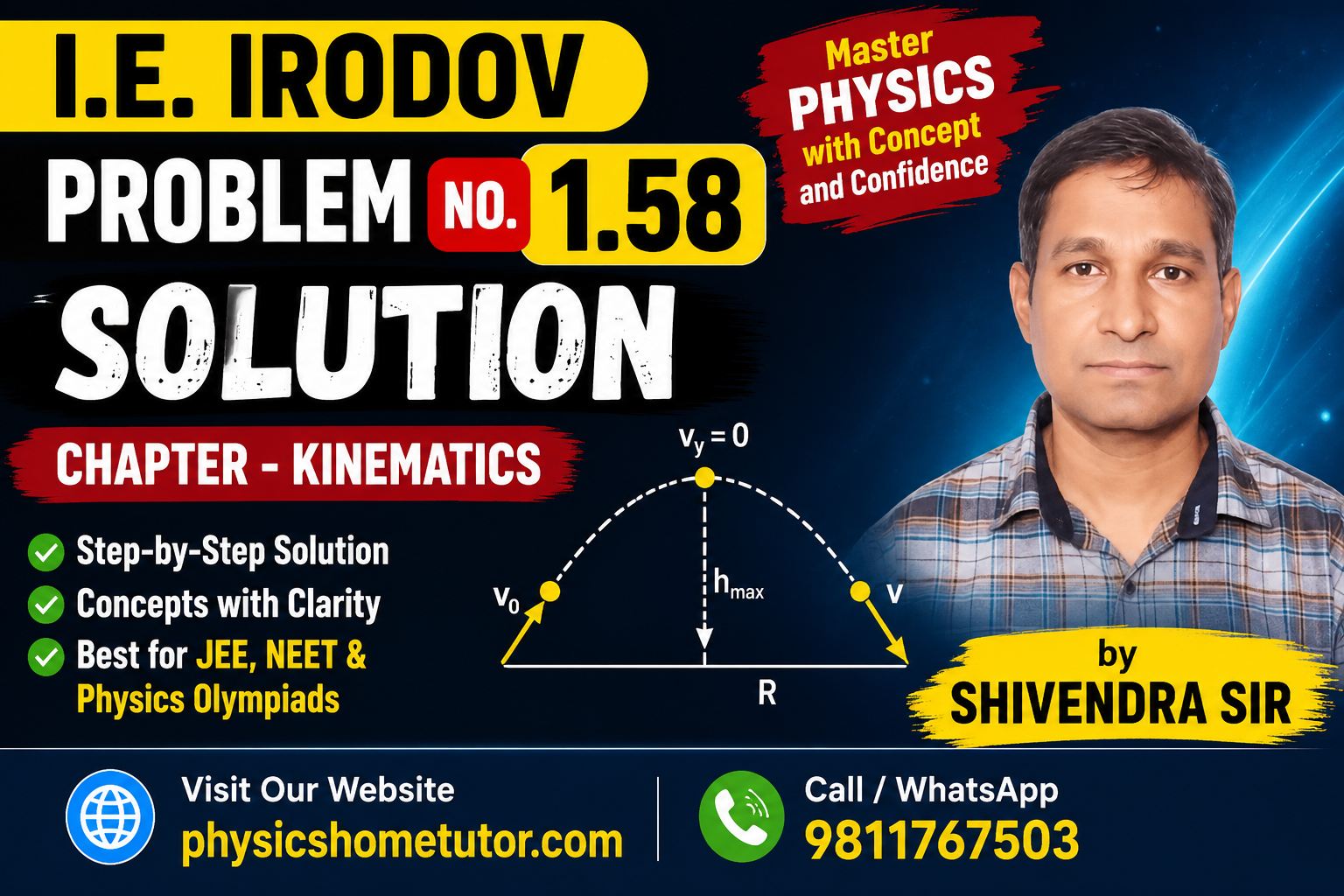

Physics is one of the most concept-driven subjects in competitive examinations, and mastering it requires solving high-quality problems. Among the best books for developing analytical thinking is I.E. Irodov's Problems in General Physics. In this article, we present the I.E. Irodov Problem 1.58 Solution from the Kinematics chapter with a clear conceptual explanation.
This problem is particularly useful for students preparing for JEE Advanced, JEE Main, NEET, Physics Olympiad, and engineering entrance examinations. Instead of simply applying formulas, students learn how to analyze motion logically and systematically.
Why Solve I.E. Irodov Problems?
I.E. Irodov problems are famous for strengthening conceptual understanding rather than promoting rote learning. Every question demands logical reasoning and a strong grasp of the fundamentals.
Benefits of solving I.E. Irodov include:
- Improves analytical thinking.
- Develops advanced problem-solving skills.
- Strengthens understanding of kinematics.
- Prepares students for difficult competitive exams.
- Enhances confidence in tackling challenging numerical problems.
Problem 1.58 is an excellent example of applying multiple kinematics concepts together.
Concepts Required for Problem 1.58
Before attempting this problem, students should be comfortable with the following topics:
- Equations of motion
- Relative motion
- Projectile motion
- Velocity and acceleration
- Graphical interpretation of motion
- Vector analysis
- Time-dependent motion
Understanding these concepts makes solving the problem much easier and helps avoid common mistakes.
Step-by-Step Solution Strategy
Instead of memorizing shortcuts, follow a systematic approach.
Step 1: Read the Problem Carefully
Identify:
- Given quantities
- Unknown quantities
- Initial conditions
- Required final result
Drawing a neat diagram often simplifies the analysis.
Step 2: Identify the Motion
Determine whether the motion is:
- Uniform
- Uniformly accelerated
- Projectile motion
- Relative motion
- Combination of different motions
Choosing the correct model is the key to solving the problem efficiently.
Step 3: Apply the Appropriate Equations
Use the standard kinematics equations wherever applicable:
- v=u+at
- s=ut+21at2
- v2=u2+2as
If the motion involves vectors, resolve the velocity into horizontal and vertical components before proceeding.
Step 4: Perform Mathematical Calculations
Carry out algebra carefully.
Keep track of:
- Units
- Positive and negative signs
- Vector directions
- Intermediate results
Many students lose marks due to calculation errors rather than conceptual mistakes.
Step 5: Verify the Final Answer
Before concluding:
- Check dimensional consistency.
- Verify physical meaning.
- Ensure the answer satisfies the given conditions.
This habit significantly reduces mistakes in examinations.
Common Mistakes Students Make
While solving I.E. Irodov Problem 1.58, students often make the following errors:
- Choosing incorrect equations of motion.
- Ignoring vector directions.
- Mixing horizontal and vertical motion.
- Calculation mistakes.
- Forgetting SI units.
- Incorrect sign convention.
- Skipping conceptual analysis.
Avoiding these mistakes can dramatically improve accuracy.
How This Problem Helps in JEE Advanced
Questions in JEE Advanced are designed to test conceptual clarity rather than formula memorization.
Problem 1.58 helps students learn:
- Logical reasoning
- Multi-step problem solving
- Mathematical accuracy
- Application of fundamental principles
- Time management during exams
These skills are valuable not only in JEE but also in Olympiads and university entrance examinations.
Tips to Master Kinematics
To become confident in kinematics:
- Study NCERT thoroughly.
- Understand every derivation.
- Practice daily.
- Solve H.C. Verma before moving to I.E. Irodov.
- Maintain a notebook of mistakes.
- Revise important formulas regularly.
- Focus on concepts rather than shortcuts.
Consistent practice is the only way to master advanced physics.
Learn with Shivendra Sir
If you are looking for expert guidance in Physics, Shivendra Sir provides concept-based teaching with detailed problem-solving methods suitable for competitive examinations.
Students receive:
- Personalized Physics coaching
- JEE Advanced preparation
- NEET Physics guidance
- Olympiad-level problem solving
- Online and offline classes
- Doubt-clearing sessions
- Complete chapter-wise practice
Watch the Complete Video Solution
For a detailed explanation of I.E. Irodov Problem 1.58, watch the complete video tutorial by Shivendra Sir, where every concept and calculation is explained step by step.
🌐 Website: https://physicshometutor.com
📞 Call/WhatsApp: 9811767503
Conclusion
The I.E. Irodov Problem 1.58 Solution is an excellent exercise for strengthening your understanding of Kinematics. It teaches students how to think analytically, apply the correct principles, and solve challenging numerical problems with confidence.
If you aspire to excel in JEE Advanced, NEET, or Physics Olympiad, solving I.E. Irodov problems consistently is one of the best ways to improve your conceptual understanding and problem-solving skills. Practice regularly, focus on the underlying concepts, and review your mistakes to achieve mastery in Physics.