Are you an IIT-JEE or NEET aspirant struggling with the complexities of advanced mechanics? You are not alone. Many students find classical mechanics intimidating, especially when it comes to the legendary problems posed by I.E. Irodov. It is completely normal to feel overwhelmed by these questions initially; however, with the right approach and clear foundational concepts, mastering them is entirely possible.
In this comprehensive guide, we are going to dive deep into the IE Irodov Problem 1.87 solution from the Chapter Law of Motion. Brought to you by Shivendra Sir at physicshometutor.com, this article will break down the free-body diagrams, the constraint relations, and the mathematical framework needed to conquer this problem. If you need personalized guidance for your exam preparation, you can always reach out directly to Shivendra Sir at 9811767503. Let's unravel the physics behind the problem!
Why I.E. Irodov is Crucial for JEE and Advanced Physics
Before we jump into the solution, it is important to understand why I.E. Irodov's Problems in General Physics is considered the holy grail for engineering and medical aspirants. The problems in this book do not merely test your ability to plug numbers into standard formulas; they test your conceptual clarity, your ability to visualize complex physical systems, and your proficiency in mathematical application.
The Chapter Law of Motion is particularly foundational. If you build a strong conceptual grip here, subsequent chapters like Work-Energy, Rotational Mechanics, and Electromagnetism become significantly easier to grasp. Problem 1.87 is a perfect example of a question that requires a methodical approach to identifying all forces acting on a system, choosing the correct reference frames, and applying Newton's Second Law with precision.
Analyzing the System: Free-Body Diagrams (FBD)
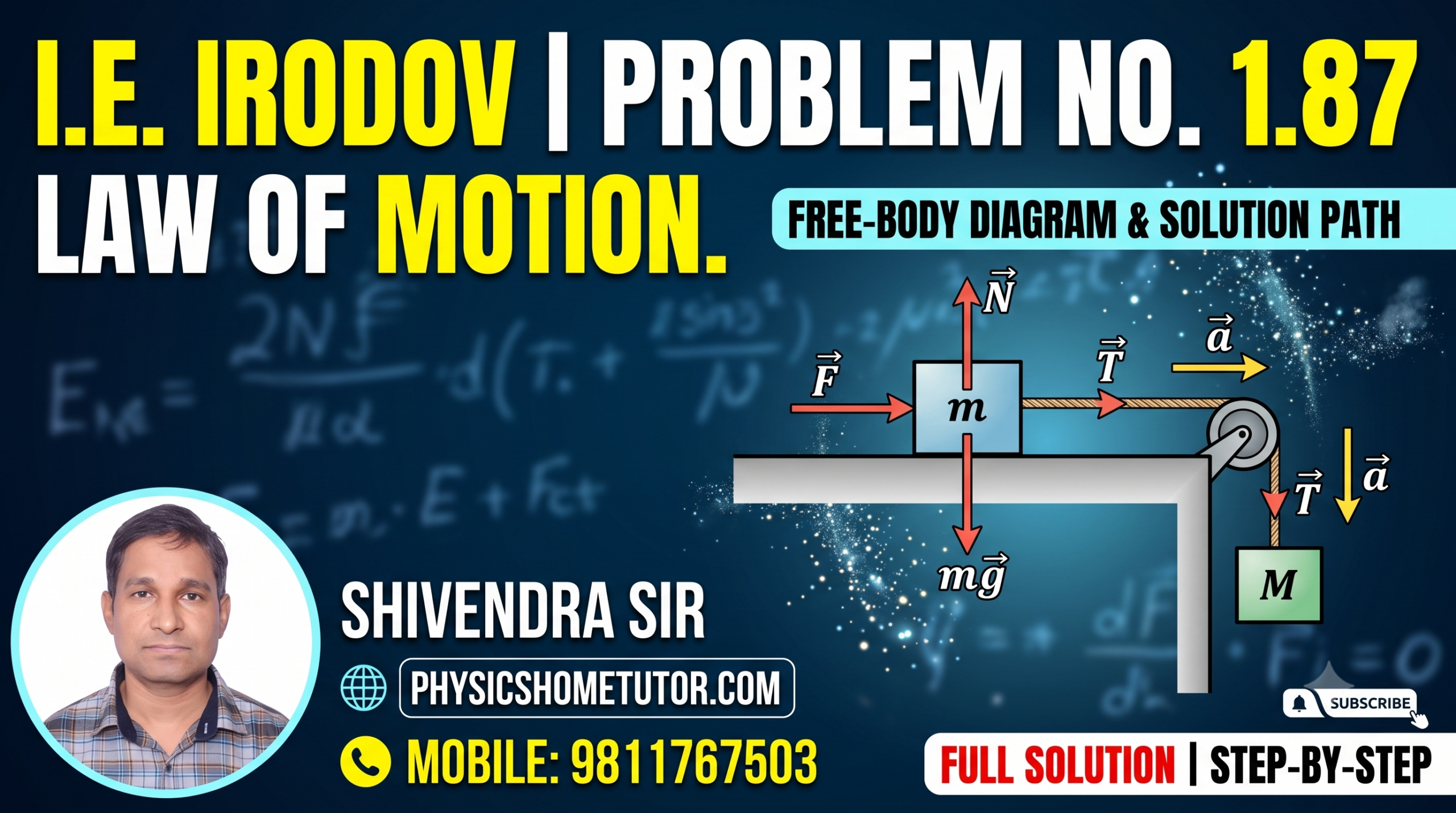
As depicted in our accompanying video thumbnail, the problem involves a system of interconnected masses where we must account for tension, applied forces, and gravity. To solve any complex mechanics problem, the absolute first step—and arguably the most critical one—is drawing an accurate Free-Body Diagram (FBD) for every distinct mass in the system.
Let us isolate the components based on standard block-and-pulley mechanics:
- Mass $m$ (on the horizontal surface): This block is subjected to multiple forces. Vertically, we have the downward gravitational force $mg$ balanced by the upward normal reaction force $\vec{N}$ from the surface. Horizontally, there is an applied pull force $\vec{F}$, the tension $\vec{T}$ from the connecting string pulling in the opposite direction, and potentially frictional forces depending on the specific problem conditions.
- Mass $M$ (the hanging block): For the vertically hanging mass, the forces are simpler. There is the downward gravitational pull $Mg$ and the upward tension $\vec{T}$ from the string.
By clearly mapping out these vectors, we eliminate confusion and set up a reliable foundation for our algebraic equations. Shivendra Sir always emphasizes to his students: A correct FBD is half the problem solved.
Step-by-Step Mathematical Solution
Now, let us translate our visual diagrams into mathematical language using Newton's Second Law of Motion:
$$\sum \vec{F} = m\vec{a}$$
1. Equations for Mass $m$
Assuming the block on the table moves to the right with an acceleration $a$, we sum the forces in the horizontal ($x$) and vertical ($y$) directions.
For the vertical equilibrium ($y$-axis):
$$N - mg = 0 \implies N = mg$$
For the direction of motion ($x$-axis):
$$\sum F_{x} = F - T = m a$$
(Note: If the surface is rough, a kinetic friction term $f_{k} = \mu_{k} N$ must be subtracted from the forward forces).
2. Equations for Mass $M$
Assuming the string is inextensible, the magnitude of acceleration $a$ for mass $M$ is the exact same as for mass $m$. Because mass $m$ is moving to the right, mass $M$ must be moving downward.
Applying Newton's Second Law in the vertical direction for the hanging mass:
$$Mg - T = M a$$
3. Solving the System of Equations
We now have a system of linear equations. To find the common acceleration $a$, we can manipulate the equations to eliminate the internal tension force $T$. Let's solve for $T$ in the first equation and substitute it into the second.
From the first equation:
$$T = F - m a$$
Substitute this into the second equation:
$$Mg - (F - m a) = M a$$
$$Mg - F + m a = M a$$
$$Mg - F = M a - m a$$
$$Mg - F = a(M - m)$$
$$a = \frac{Mg - F}{M - m}$$
Once the acceleration $a$ is found, you can substitute this mathematical value back into either of the original FBD equations to solve for the precise tension $T$ in the string. This systematic, step-by-step substitution method is exactly how Shivendra Sir teaches complex problem-solving.
Common Pitfalls to Avoid in Laws of Motion
When tackling the IE Irodov Problem 1.87 solution, students frequently make a few predictable errors. Being aware of these can save you valuable time and lost marks during competitive exams.
- Ignoring Vector Directions: Force, acceleration, and velocity are vectors. A common mistake is assigning the wrong algebraic sign (+ or -) to a force opposing the motion. Always define your positive coordinate axis in the direction of your assumed acceleration.
- Misinterpreting Constraint Relations: Assuming both blocks have the same acceleration is only valid if they are connected by a single, simple, taut string. If movable pulleys are introduced, the accelerations will differ based on constraint equations.
- Overlooking Friction Parameters: Always read the problem statement carefully to verify whether the surfaces are smooth or rough. Missing a friction coefficient will lead to fundamentally incorrect base equations.
Elevate Your Physics Preparation with Physics Home Tutor
Understanding the theoretical framework of the Chapter Law of Motion is one thing, but applying it flawlessly under the high-pressure time constraints of an exam is another. If you find yourself consistently stuck on Irodov problems or similar advanced exercises, seeking expert help is a smart, strategic move.
Shivendra Sir provides top-tier physics coaching designed to build your confidence and analytical skills from the ground up. Whether you need help with a specific tricky concept or require a comprehensive, rigorous study plan for IIT-JEE or NEET, professional guidance makes all the difference. You do not have to navigate these challenging subjects alone.
Contact Details for Online & Offline Classes:
- Instructor: Shivendra Sir
- Website: physicshometutor.com
- Mobile / WhatsApp: 9811767503
Conclusion
Conquering classical mechanics takes patience, consistent practice, and the right mentorship. By breaking down the IE Irodov Problem 1.87 solution, we can see that even the most complex systems perfectly adhere to the fundamental Laws of Motion. Keep practicing your free-body diagrams, double-check your algebraic signs, and don't hesitate to reach out to Physics Home Tutor for expert support. Keep pushing your limits, and happy studying!