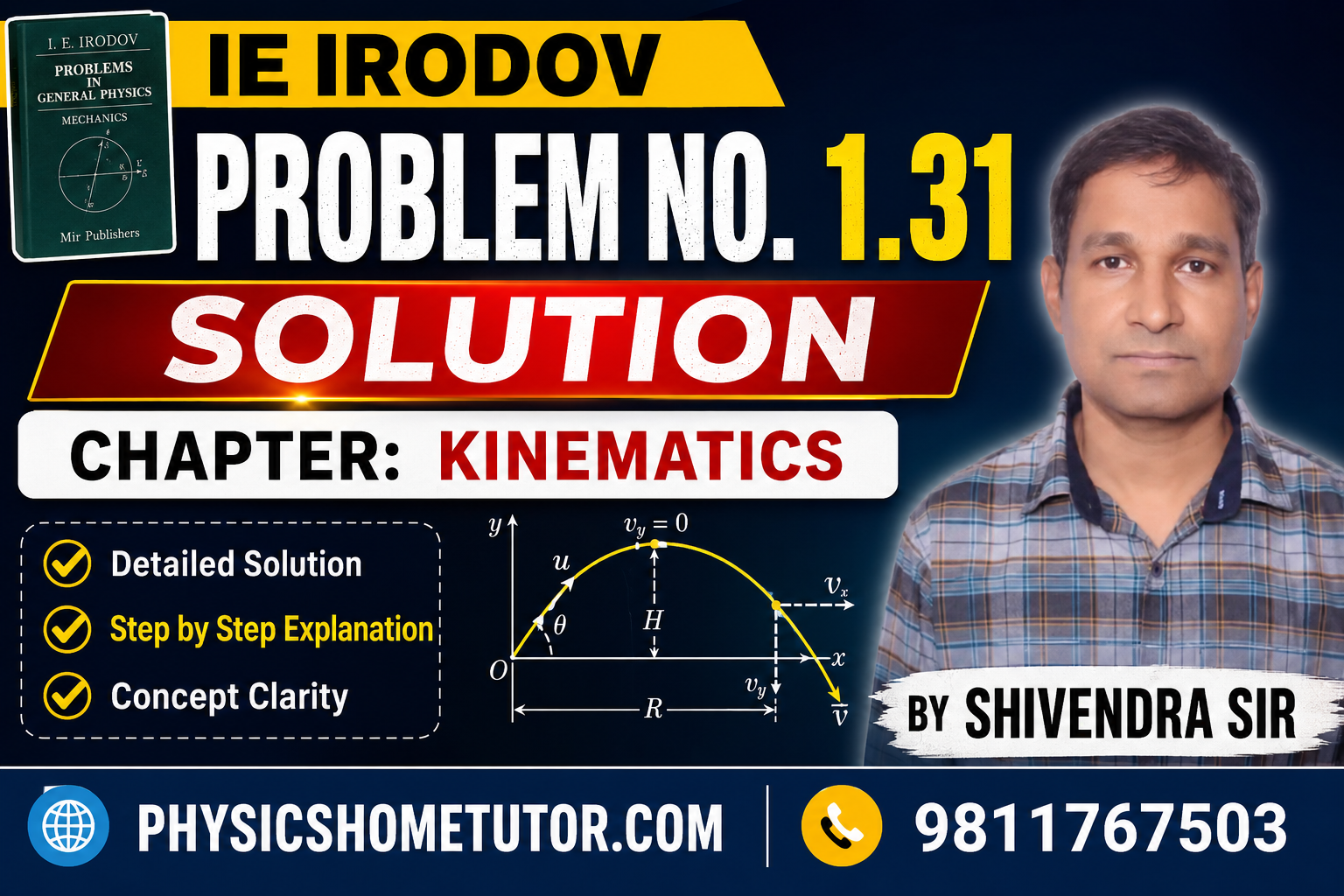

In this article, we discuss the IE IRODOV Problem No. 1.31 Solution from the Kinematics chapter. The objective is not only to obtain the correct answer but also to understand the physical principles and reasoning involved in solving such problems. Why Study I.E. Irodov Problems? Many students focus only on formula-based questions and miss the deeper conceptual understanding required for advanced examinations. I.E. Irodov problems challenge students to think analytically and apply fundamental concepts in new situations. Benefits of solving Irodov problems include: Strong conceptual foundation Improved analytical thinking Better understanding of motion and vectors Enhanced problem-solving speed Preparation for JEE Advanced and Olympiads Problem No. 1.31 is a classic example that tests a student's understanding of kinematics and motion analysis. Concepts Required for Problem No. 1.31 Before attempting the solution, students should be comfortable with the following topics: 1. Equations of Motion The basic equations of uniformly accelerated motion are frequently used in kinematics problems: First equation of motion Second equation of motion Third equation of motion Understanding when and how to apply these equations is essential. 2. Vector Representation Many Irodov problems involve motion in more than one dimension. Therefore, students must understand: Vector addition Vector subtraction Components of vectors Relative direction of motion 3. Graphical Interpretation Sometimes the easiest way to solve a kinematics problem is by drawing diagrams and understanding the physical situation visually. 4. Relative Motion A strong understanding of relative velocity and relative displacement often simplifies complex questions. Step-by-Step Approach to Solving Problem No. 1.31 When solving Problem No. 1.31, it is important to avoid directly substituting formulas. Instead, follow a systematic process. Step 1: Read the Problem Carefully Identify: Given quantities Required quantity Type of motion involved Constraints in the problem Many students lose marks because they overlook critical information provided in the question. Step 2: Draw a Proper Diagram A well-labeled diagram helps visualize: Initial position Final position Direction of motion Velocity vectors Acceleration vectors This step often reveals the correct method of solution. Step 3: Choose an Appropriate Coordinate System Selecting suitable coordinate axes simplifies calculations and reduces mistakes. Step 4: Apply Kinematic Relationships Use the relevant equations and vector relationships carefully. Remember: Physical interpretation is more important than memorizing formulas. Every equation used should have a clear justification. Step 5: Verify Units and Direction After obtaining the answer: Check dimensional consistency. Verify signs and directions. Ensure the final result makes physical sense. Common Mistakes Students Make While solving Problem No. 1.31, students often commit the following errors: Ignoring Vector Nature Velocity and displacement are vector quantities. Treating them as scalars can lead to incorrect answers. Wrong Sign Convention Positive and negative directions must be defined clearly before beginning calculations. Formula Misapplication Using equations of uniformly accelerated motion without checking whether acceleration remains constant can produce wrong results. Skipping Diagrams Many students underestimate the importance of diagrams. However, visual representation often makes the solution straightforward. Exam Relevance The concepts involved in IE IRODOV Problem No. 1.31 Solution are highly relevant for: JEE Advanced Questions based on: Relative motion Projectile motion Vector kinematics Multi-dimensional motion frequently appear in JEE Advanced examinations. Physics Olympiads Olympiad questions often require deeper conceptual understanding similar to the thinking process used in Irodov problems. Engineering Entrance Exams Strong kinematics fundamentals improve performance in all physics-based competitive examinations. Tips to Master Irodov Kinematics Problems Practice Consistently Solve at least one challenging kinematics problem daily. Focus on Concepts Understand why a method works rather than memorizing solution steps. Analyze Alternative Methods Try solving the same problem using different approaches. Maintain a Formula Sheet Create a concise formula notebook for quick revision. Review Mistakes Every mistake is an opportunity to strengthen conceptual understanding. Learn Physics with Shivendra Sir At Physics Home Tutor, students receive personalized guidance for: JEE Main JEE Advanced NEET Physics Olympiads Board Examinations Each topic is explained through concept-building, problem-solving techniques, and advanced applications. Contact Details Website: physicshometutor.com Mobile: 9811767503 Faculty: Shivendra Sir Conclusion The IE IRODOV Problem No. 1.31 Solution from the Kinematics chapter is an excellent exercise for developing advanced problem-solving skills. By focusing on concepts, vector analysis, and systematic reasoning, students can significantly improve their understanding of motion and prepare effectively for competitive examinations. Regular practice of Irodov problems helps students move beyond routine formula application and develop the analytical mindset required for success in JEE Advanced, Olympiads, and other high-level physics examinations. Keep practicing, stay consistent, and continue strengthening your physics fundamentals with expert guidance from Shivendra Sir.